Cheng Li
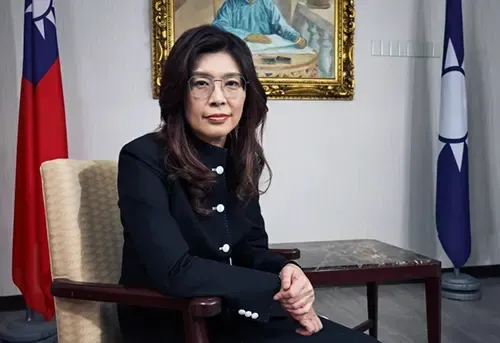
US President Donald Trump is scheduled to visit China this week. In anticipation of this visit, activity surrounding the issue of Taiwan has intensified. Cheng Li-un, a leader of the island nation’s opposition, has stated that it is possible to maintain relations with both the United States and China. He visited China a short while ago. Washington is currently pressuring Taiwan to increase its defense spending in order to counter Chinese aggression. However, Cheng—one of the island’s most influential political figures—has articulated a completely different stance. In his view, dialogue—rather than conflict—is the key to Taiwan’s security. Speaking in an interview with CNN shortly after meeting with Chinese President Xi Jinping in Beijing—and just days before Donald Trump’s visit to China—Cheng, the Chairperson of Taiwan’s main opposition party, the Kuomintang (KMT), asserted that Taiwan’s security cannot be ensured through weaponry alone.
He stated that Taiwan has no desire to ever become “the next Ukraine.” Cheng made these remarks at a time when Taiwan’s opposition-controlled parliament had approved a defense budget of approximately $40 billion—a proposal originally put forward by President Lai Ching-te. Following a prolonged political impasse, the budget was ultimately passed after being reduced by roughly one-third. While the approved budget allocates substantial funds for purchasing weaponry from the United States, allocations for various projects aimed at enhancing Taiwan’s indigenous defense capabilities—particularly within the drone industry—have been cut. This decision comes at a juncture when the Trump administration is urging its Asian allies to assume greater responsibility in countering China. US officials and military analysts have long raised questions regarding whether the KMT is deliberately hindering Taiwan’s military modernization efforts. In recent times, Chinese military activity in the vicinity of Taiwan has increased significantly. Nevertheless, Cheng maintains that the KMT remains a staunch supporter of Taiwan’s national defense.
He further added that a significant portion of the $40 billion budget remained vague. “It was simply not possible for us to blindly approve the entire package,” he said. Meanwhile, Matt Pottinger, a former Deputy National Security Advisor in the Trump administration, urged Taiwan’s opposition party—in comments published in local media—to seriously reconsider its decision to cut funding for the drone sector. He noted that drones are a cost-effective and potent technology that even major global powers find difficult to counter. Amidst this debate, a meeting between Trump and Xi Jinping is scheduled to take place in Beijing, where the Taiwan issue is expected to be a key topic of discussion. Cheng stated that Taiwan should not be forced to choose sides between the United States and China. In his words, maintaining friendly relations with the United States does not necessarily imply hostility toward China. A few weeks ago, Cheng visited Beijing and held a meeting with Xi Jinping.
This marked the highest-level meeting in a decade between the Chinese Communist Party and Taiwan’s main opposition party. Cheng—who once campaigned against the KMT and advocated for Taiwan’s independence—now leads the party and also supports the “One China” policy, which Beijing has consistently regarded as the foundation for political dialogue between the two sides. Cheng emphasized that, despite the significant differences between the two sides, it is imperative to find a path toward dialogue. “I believe this is the only way to avoid war,” he said. However, critics allege that Cheng is merely echoing Beijing’s rhetoric—a stance they view as dangerous for Taiwan’s democracy. In particular, many interpret his remarks regarding “external interference” as an indirect criticism of the United States and Japan—two of Taiwan’s closest partners. According to Taiwanese security officials, Beijing is attempting to leverage Cheng’s diplomatic engagement to portray Taiwan on the international stage as politically divided and less aligned with Washington. Meanwhile, even as Cheng was meeting with Chinese officials, Chinese warplanes and naval vessels continued to patrol the waters surrounding Taiwan.
Cheng noted that China has made it explicitly clear that it would resort to military force if Taiwan were to pursue independence. Nevertheless, he maintains that tensions can be de-escalated through dialogue. He asserts that if the KMT returns to power, military tensions and confrontations would subside, making it possible to completely avert the threat of war. Cheng’s rapid political rise has sparked fresh debate within Taiwanese politics. Known for his candor—being both forthright and concise—he has already garnered widespread recognition.
Speculation is also rife that he may emerge as a candidate in the 2028 presidential election. However, without directly addressing this matter, he stated: “My primary objective right now is to ensure a KMT victory in the local elections and to lay the groundwork for bringing the party back to power in 2028.” He added that the next two to three years will be a critical period for Taiwan’s future.