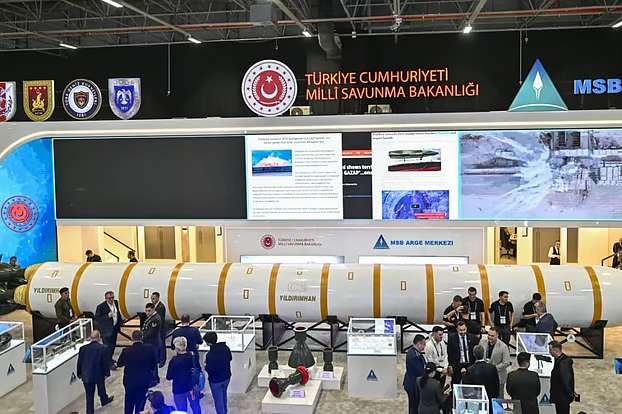
With the aim of achieving self-reliance in defense equipment production and consolidating its position as a key military power among Middle Eastern and NATO nations, Turkey has unveiled its first Intercontinental Ballistic Missile (ICBM).
The name of this missile translates to “lightning” or “thunderbolt” in Bengali. In Turkish, it is named “Yıldırımhan.” It was developed at the Research and Development Center of Turkey’s Ministry of Defense. A prototype—or initial model—of the missile was showcased last Tuesday at the “SAHA 2026” Defense and Aerospace Exhibition held at the Istanbul Expo Center.
**Why This Missile Is Significant**
According to data provided by the Turkish news agency Anadolu, the Yıldırımhan missile boasts a range—or operational capability—of 6,000 kilometers (3,728 miles).
According to the Federation of American Scientists, any ballistic missile with a range exceeding 5,500 kilometers (approximately 3,418 miles) is classified as an Intercontinental Ballistic Missile, or ICBM.
If launched from Turkey, this missile would be capable of striking any target across Europe, Africa, and Asia. The Yıldırımhan will reach a maximum speed 25 times that of sound (Mach 25). It is powered by four rocket engines and utilizes liquid nitrogen tetroxide as its propellant. The missile is capable of carrying a warhead weighing up to 3,000 kilograms.
Turkey has not yet commenced commercial production of this missile. Speaking at an exhibition held in Istanbul last Tuesday, the country’s Defense Minister, Yaşar Güler, stated: “In the current era—where economic cost has emerged as a formidable weapon in itself—Turkey is offering its allies not merely weaponry, but also technology and a sustainable security framework.”
Experts suggest that there are several key factors underpinning Turkey’s acquisition of this intercontinental missile development capability. Özgür Ünlühisarcıklı, the regional director of the Washington-based think tank “German Marshall Fund,” told Al Jazeera, “In my opinion, Turkey does not currently need this ICBM to counter any immediate security threats. Therefore, what is most important for Turkey is not the missile itself, but rather the acquisition of the capability to build it.”
**New Horizons in Space Research**
Istanbul-based defense analyst Burak Yıldırım believes that the design of this intercontinental missile will indirectly play a significant role in Turkey’s civilian space research efforts. In particular, it will be instrumental to “Delta-V”—Turkey’s commercial project aimed at launching satellites into space using its own indigenous rockets.
Burak Yıldırım further told Al Jazeera, “The physics involved in reaching orbital space and traversing intercontinental distances are closely intertwined. The same types of technologies are utilized in both instances. In that sense, possessing a robust space research program makes the acquisition of ICBM-building capabilities a natural progression—even if its significance is far greater in the political realm.”
The missile is capable of striking any target across Europe, Africa, and Asia. The *Yıldırımhan* boasts a top speed exceeding 25 times the speed of sound (Mach 25). It is powered by four rocket engines and is designed to carry a payload weighing 3,000 kilograms.
**Ambition or Reality?**
Defense analyst Burak Yıldırım offers a cautionary note: “What was showcased at the SAHA 2026 exhibition is, in essence, merely a preliminary concept or a mock-up. This missile has yet to undergo any successful flight tests, and very little information has been made available regarding its technical specifications. Furthermore, the designated site where the testing is expected to take place—a base in Somalia—has not yet been completed. Consequently, at this juncture, it remains merely a declared objective rather than an operational capability ready for deployment.”
However, Ali Bakir, a Senior Fellow at the “Middle East Council on Global Affairs,” views this prototype—or mock-up—as a major achievement for Ankara. He told Al Jazeera, “This advancement has elevated Turkey’s missile technology and capabilities to unprecedented heights. With this achievement, Turkey has joined the ranks of the select few nations globally that possess such advanced defense technology.”
Bakir further added, “This milestone not only underscores Ankara’s commitment to bolstering its military might but will also further reinforce its operational capabilities. Through this initiative, Turkey seeks to establish itself as a major regional power.”
**Why Turkey Developed ‘Yildirimhan’**
Turkey unveiled this new missile amidst escalating tensions in the Middle East. Although a fragile ceasefire currently holds following a six-week bloody conflict between Iran on one side—and the United States and Israel on the other—a form of naval warfare continues to persist in the Gulf region.
While Tehran has effectively blockaded the Strait of Hormuz, the United States has imposed a naval blockade on Iranian ports. Meanwhile, Israel has repeatedly violated the ceasefires currently in effect in Lebanon and the Gaza Strip.
Last March, as Iran was launching retaliatory strikes targeting U.S. military installations across the Middle East, Turkey reported that NATO’s air defense systems had successfully intercepted and shot down ballistic missiles heading toward its territory on March 4 and 9. However, Tehran denied any involvement in these attacks, suggesting instead that Israel may have orchestrated the incidents as part of a sabotage campaign.