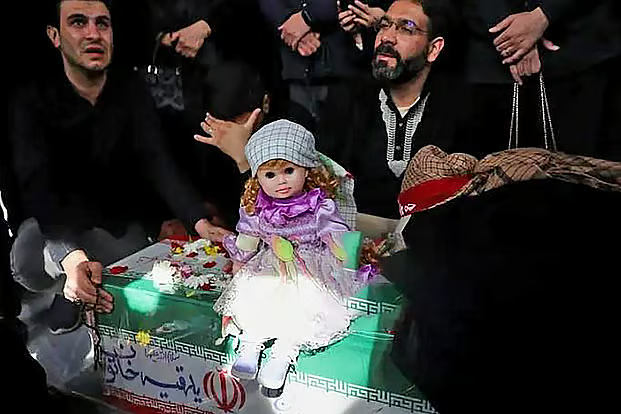
Two-year-old Zainab Sahebi was laid to rest in Tehran. Her favorite doll lay beside the coffin of the child, who was killed in an Israeli airstrike. March 7, 2026. File photo: Reuters.
The number of children killed or injured in the ongoing conflict across the Middle East—spanning Iran and neighboring US-allied nations—has surpassed 4,000.
Abdou Fofana, UNICEF’s Acting Regional Director for the Middle East and North Africa, disclosed this information in a statement.
The statement, published on UNICEF’s website last Friday, notes that the repercussions of the war persist across Iran and neighboring countries. Consequently, children are losing their lives or suffering permanent disabilities in places where they should be safest—their homes, schools, and neighborhoods.
Most recently, reports indicate that a two-year-old child was killed alongside their parents in a US strike on a residential building on Qeshm Island, off Iran’s southern coast, on July 30. Two other children were injured in the incident, according to the statement.
In the statement, the UNICEF official emphasized that recent attacks demonstrate how children across the region are paying the heaviest price for the conflict. Over the past five months of fighting, more than 4,000 children have been killed or injured across six countries in the region. Of these, the casualty count in Iran alone exceeds 2,500; the ongoing conflict there has claimed the lives of 386 children and left another 2,117 injured.
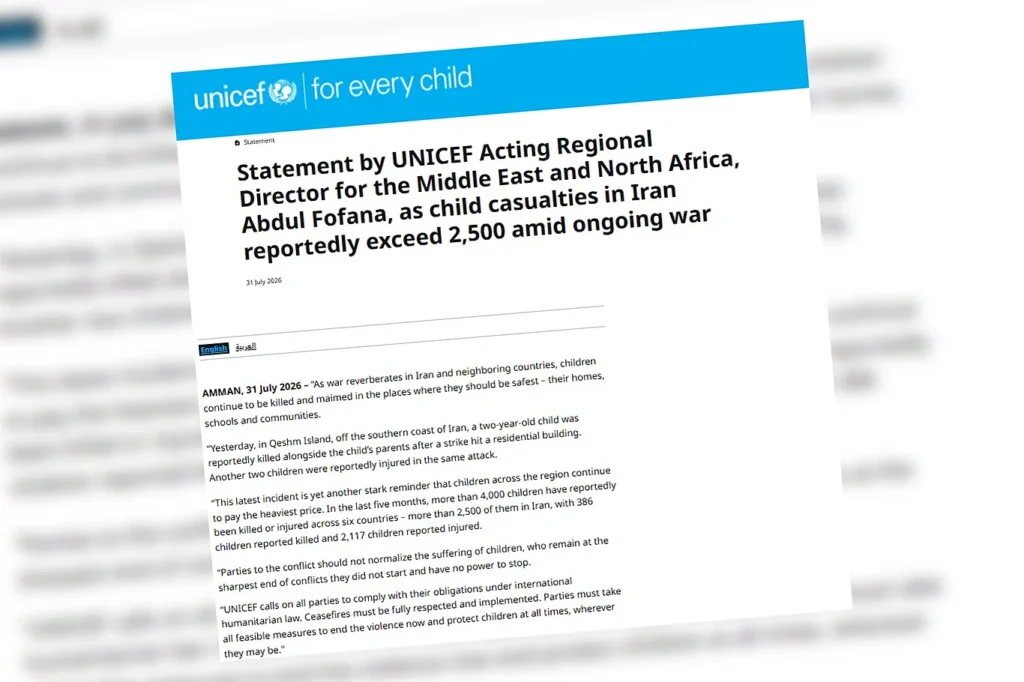
“Parties to the conflict must not accept such suffering of children as the norm. Children are the most devastating victims of a conflict they did not start and have no power to stop,” said Abdou Fofana.
UNICEF has called upon the warring parties in the Middle East to adhere to their obligations under international humanitarian law. The statement urged full respect for and implementation of a ceasefire, demanding an immediate end to the violence. It emphasized that all possible measures must be taken to ensure the constant protection of children, wherever they may be.