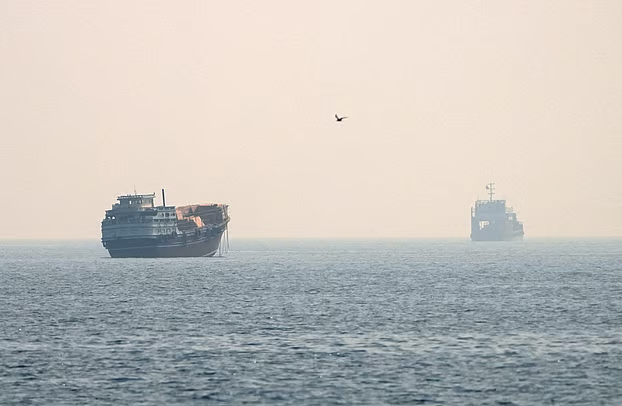
Smoke is seen rising from a boat in Banud, in Iran's Bushehr province. The explosion occurred in the vicinity of the Bushehr nuclear facility. July 9, 2026, Bushehr province. Photo: Reuters.
Explosions were heard across various parts of Iran yesterday, Thursday. Meanwhile, US military officials have denied any involvement in these new attacks.
According to a report by the Iranian news agency Mehr, multiple explosions were heard late Thursday night in the vicinity of Bushehr and the nearby town of Choghadak. Bushehr is home to one of Iran’s nuclear facilities.
The report further stated that three additional explosions were heard in the southern city of Konarak.
Shortly thereafter, US Central Command informed Al Jazeera that the US military had not conducted any attacks in Iran over the past few hours.
The United States and Iran have been trading attacks since last Tuesday. Tehran has also struck US military bases in the Persian Gulf region, including those in Qatar, Bahrain, and Kuwait. This exchange of fire has placed the fragile ceasefire agreement—reached in mid-June—at greater risk.
Mehr News Agency did not provide detailed information regarding the cause of the explosions, the extent of damage, or any casualties.
Ehsan Jahanian, the Deputy Governor for Political and Security Affairs in Bushehr, told the state-run media outlet IRNA that the explosion in the city was caused by the air defense system.
Jahanian added that a “projectile” or missile-like object had struck a military base on the outskirts of Bushehr.
War ‘not over’
Shortly after the news emerged from Iran, Israel’s hawkish Prime Minister Benjamin Netanyahu stated that he had spoken by phone with US President Donald Trump. According to a statement released by the Prime Minister’s Office, “During the call, they agreed to maintain coordination between the two countries across various areas.”
The statement further noted that Trump briefed Netanyahu on the latest situation regarding “US actions in the Persian Gulf.” Earlier on Thursday, speaking at an Air Force graduation ceremony at the Hatzerim airbase in southern Israel, Netanyahu said, “The war [with Iran] is not over. There are new challenges ahead.”
According to a report by the daily Yedioth Ahronoth, Netanyahu was heard saying, “Maintaining air superiority is a fundamental pillar of Israel’s national security policy. It is crucial for preserving stability in a turbulent Middle East.”
Israeli military chief Eyal Zamir also stated that military operations against Iran are “not over.”
In his brief address, the head of the Israeli forces—responsible for widespread brutality across the Middle East—said, “We have new plans on the table. It appears a major operation still awaits us. Be prepared.”
Israel’s Defense Minister stated that Israel is ready to strike Iran if necessary.
Israel Katz, the Defense Minister known for making provocative statements, said, “The army is ready to go to war to reclaim air superiority, strike Iran again, and eliminate threats. They are on high alert. We are prepared to strike a third time if needed.”
Dispute over the Strait of Hormuz
This new phase of tit-for-tat attacks began earlier this week following Iranian attacks on commercial vessels in the Strait of Hormuz. Several ships—including those from Qatar and Saudi Arabia—were targeted while traversing this narrow waterway along a route close to the Omani border.
Iran insists that all vessels must pass close to the Iranian coast. Members of the Gulf Cooperation Council (GCC) issued a joint statement strongly condemning these attacks on ships and the territories of Gulf nations.
At the root of this dispute lie two diverging perspectives on how to move forward. Trump wants shipping through the strait to normalize quickly to lower fuel prices ahead of the crucial upcoming midterm elections. Iran, on the other hand, is rejecting any move that might diminish its control over shipping in the area.
Reacting sharply to the ship attacks, Trump labeled the Iranian leadership as “garbage.” He declared the agreement “dead,” although neither side has yet formally withdrawn from it.
Trump added that he might allow peace talks to continue for now, but his threatening rhetoric has cast uncertainty over the entire process. Washington has also revoked the waivers previously granted for Iranian oil exports.
While this is not the first instance of tit-for-tat attacks between the two nations—such incidents have occurred before—there is growing concern that both sides could escalate hostilities, potentially dragging the region into a wider war.
This situation has arisen at a time when technical discussions with negotiators have been suspended. The suspension was put in place to accommodate the burial proceedings of Supreme Leader Ayatollah Ali Khamenei, who died on February 28. Following the recent attacks, it remains uncertain whether the talks will resume next Monday as originally scheduled.