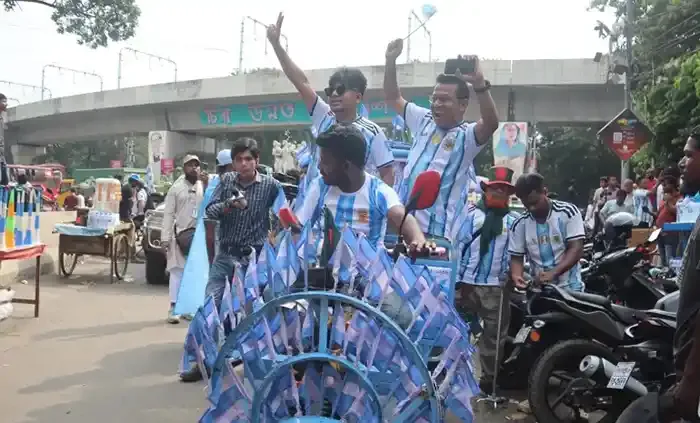
The giant screen broadcast has ended, yet the chants of “Argentina! Argentina! Messi! Messi!” still echo from the voices of thousands of fans. Vuvuzelas blare all around; the entire area has transformed into a sea of sky-blue and white. Just moments ago, Argentina’s talisman, Lionel Messi, completed a hat-trick in the World Cup opening match against Algeria. Young fans, draped in Argentine flags, dance on each other’s shoulders and sing, continuing their celebrations long after the final whistle. Witnessing the scene, one might mistake it for a street in Buenos Aires. In reality, however, this is Dhaka, the capital of Bangladesh—located nearly 17,000 kilometers away from the Argentine capital.
Bangladesh has never qualified for the FIFA World Cup. Yet, every four years, whenever Argentina takes the field, neighborhoods across the country erupt in celebration. Giant screens are set up on university campuses and in residential areas, apartment complexes host all-night match-viewing parties, and the streets are awash in Argentina’s sky-blue and white colors.
It started with Maradona
For 50-year-old Abdul Hai from Dhaka, the love for Argentina did not begin with Messi. He says he fell in love with the team when Argentina won the title under Diego Maradona’s leadership in the 1986 World Cup. “I fell in love with Maradona back in 1986,” Hai says. “I was very young then, but I saw with my own eyes how people were going wild over him. His style of play, his passion, his skill—even the ‘Hand of God’ goal—everything captivated us. He became a legend to us.”
Argentina had to wait another 36 years to win the World Cup again. That wait finally ended in 2022 at the Qatar World Cup under Messi’s captaincy. “The wait was worth it,” Hai says. “After seeing the World Cup trophy in Messi’s hands, I have no more regrets regarding football. This time, I am watching the World Cup with deep joy rather than the anxiety I used to feel.” 1986 Was the Turning Point
Shafiqul Islam Manik, a former player and coach of the Bangladesh national football team, notes that Abdul Hai’s story mirrors that of most Argentina supporters in Bangladesh. According to Manik, it all began in 1986—specifically with the victory over England following the Falklands War and Maradona’s subsequent World Cup triumph. These two events changed everything. Witnessing Maradona’s extraordinary individual brilliance, Bangladeshi football fans gradually gravitated toward supporting Argentina. He observes that while there were already many Brazil supporters—owing to the team’s multiple World Cup titles and legendary players—Argentina emerged as Brazil’s primary rival. Before this, the majority of people in Bangladesh supported Brazil; however, after 1986, Argentina began to build a strong fan base. He believes that Argentina’s defeat in the 1990 World Cup final and Maradona’s tears deeply resonated with the emotions of the Bangladeshi people. When Maradona failed to win the trophy and wept after the final, ordinary Bangladeshis were moved to tears as well. From that point on, support for Argentina became firmly established. This explains why teams like Germany or Italy never gained significant popularity in Bangladesh; Brazil and Argentina had already captured the hearts and emotions of the people.
From Football to Diplomacy
The love for Argentina in Bangladesh has also influenced diplomatic relations between the two nations. Argentina’s Ambassador to Bangladesh, Marcelo Carlos Cesa, has been known to sit among fans at various public screenings in Dhaka to watch matches and celebrate Argentina’s victories. After the frenzy surrounding Argentina during the 2022 World Cup garnered global attention, the government in Buenos Aires reopened its embassy in Dhaka in 2023—after a hiatus of 45 years. The embassy had originally been closed in 1978 due to budget cuts under the military government. Although trade and diplomatic interests played a role in the embassy’s reopening, officials from both countries acknowledge that football played a crucial part in fostering closer ties between the two peoples.
Messi: The Hero for the New Generation
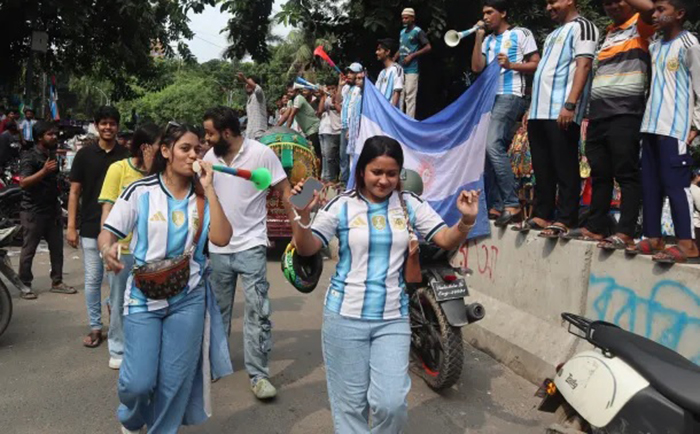
For the younger generation in Bangladesh, Messi holds far greater appeal than Maradona. Deen Islam, an employee at a private firm, says, “I have loved Argentina since childhood—especially because of Messi.” He made these remarks while participating in a ‘welcome rally’ for supporters in Dhaka, just hours before Argentina’s first match. Surrounding him, fans were beating drums, waving a massive Argentine flag, and singing as they marched along the rain-soaked streets. Many, in fact, inherited their support for Argentina from their families. Mohammad Jahir said, “My father was an Argentina supporter, and I inherited that allegiance. Later, I began to understand the game myself and fell in love with their style of play.”
4 AM Match, Yet No Sleep
With the 2026 World Cup being held in the United States, many matches are taking place late at night according to Bangladesh time. After topping their group, Argentina is set to face Cape Verde in the Round of 32—a match scheduled to kick off at 4 AM Bangladesh time. Yet, the fans’ enthusiasm remains undiminished. Jahir said with a smile, “I don’t need an alarm; when Argentina plays, I wake up on my own.”
The Argentina-Brazil Divide
Sports journalist and commentator Shahanur Rabbani believes that the legendary footballers of these two teams are the primary reason for their popularity in Bangladesh. He notes that since independence, both South American teams have achieved consistent success, with Argentina and Brazil winning the World Cup multiple times. From Maradona to Ronaldo and Rivaldo, and now Messi and Neymar—there have always been stars who drew people toward these teams. In his words, the people of Bangladesh love heroes; even though football is a team sport, they prefer to identify a hero within the team.
Divided Loyalties in the Same Family
Many families in Bangladesh are divided over which football team to support. Aiman, a sixth-grader, supports Brazil but attended an Argentina rally at his older brother’s insistence. His brother, Salman—an eighth-grader—mentions that arguments sometimes break out at home; their father supports Argentina, while their mother supports Brazil. This rivalry was also evident later while watching Messi’s hat-trick on a big screen near Dhaka University; amidst a sea of Argentina jerseys, friends teased a Brazil-supporting teenager, saying, “He had predicted a draw!”
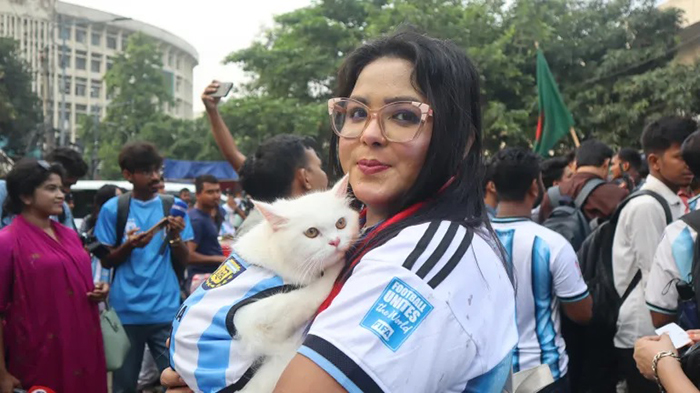
Zubaida Islam Jerin, a young political activist, was present at the rally. She proudly introduced her pet cat, which was wearing an Argentina jersey; the cat is also named Messi. Saikat Hasan, a first-year college student, described the feeling of watching Messi’s hat-trick as truly extraordinary, while his friend Mahir confidently declared, “The World Cup is ours this time.”
Will Bangladesh Ever Play in the World Cup?
However, the phrase “ours” makes journalist Shahanur Rabbani reflect. He asks, “Even though the people of Bangladesh love football so much, why hasn’t that passion translated into success for the country’s own football?” Bangladesh currently ranks 181st in the FIFA men’s rankings. “I love seeing this enthusiasm among the people, but it also saddens me. Despite such immense passion, our football—and sports in general—have failed to reach the desired level.” In his view, the root causes are a lack of infrastructure and planning; there is a shortage of adequate playing fields, training centers, and academies. There is no clear pathway for young people to become players. People are interested and want to play, but many do not know how to proceed. Former coach Shafiqul Islam Manik shares this view. He notes that while we once had talented players, no long-term plan was devised to groom the next generation. Young people do not expect to see Bangladesh in the World Cup tomorrow; they simply want a clear roadmap and to see football moving in the right direction.