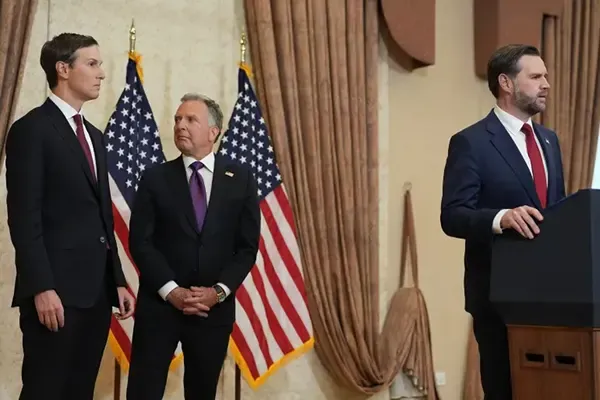
The United States is facing a crisis marked by the erosion of professional diplomacy and inexperienced leadership. Traditionally, a nation’s diplomatic team is composed of impartial professionals whose sole objective is the country’s welfare. However, the US team leading the highly sensitive and complex peace negotiations with Iran is headed by Vice President JD Vance, alongside Jared Kushner and Steven Witkoff—individuals primarily known as real estate developers with ties to the cryptocurrency sector. Kushner entered this arena by virtue of being Trump’s son-in-law, while Trump cited Witkoff’s experience in constructing over 70 high-rise buildings as his primary qualification.
Conflicts of Interest and Foreign Investment Entanglements: The US Constitution strictly prohibits officials from accepting financial benefits or “emoluments” from foreign states while holding public office. Yet, the vast majority of the $5 billion in assets managed by Kushner’s investment firm, Affinity Partners, originated from sovereign wealth funds in Gulf nations such as Saudi Arabia, the UAE, and Qatar. He even sought additional funding from these Gulf states during the height of the conflict. Kushner’s family history is also relevant here; his father, Charles Kushner, was convicted of a criminal offense in 2005 and subsequently received a presidential pardon from Trump in 2020. He was appointed as the US Ambassador to France in 2025.
Meanwhile, a company linked to the UAE’s National Security Advisor purchased a significant stake in Witkoff’s cryptocurrency venture—a deal finalized just four days before Trump’s inauguration. As intermediaries, their personal business interests are inextricably linked with these nations, often taking precedence over safeguarding US interests.
Appeasing Israel and ‘Business-Oriented’ Plans for Gaza: Both individuals maintain close ties with Israeli Prime Minister Benjamin Netanyahu. Kushner’s pro-Israel bias, in particular, is starkly evident. His family has made substantial financial contributions to Israeli settler organizations and the country’s military. Kushner and Witkoff view the Gaza Strip merely as an “investment opportunity.” According to the “Master Plan for Gaza”—drafted by the “Board of Peace” they established—the plan is to transform Gaza into a hub for cheap labor camps or factory towns, where Palestinians would be restricted from moving beyond designated zones.
Furthermore, they have a blueprint to commercially develop 70 percent of Gaza’s scenic coastline into luxury hotels within the next decade.
Fears of Temporary Deals and Disasters: Professional diplomats typically spend years conducting meticulous analysis before forging long-term international agreements (such as the nuclear deal from the Obama era). In contrast, Kushner and Witkoff lack deep knowledge of the region’s geopolitics. Driven by Trump’s haste to secure a deal at any cost and the inexperience of these two mediators, a hasty, temporary settlement or agreement might well be reached. However, because such agreements would disregard long-term U.S. interests and the overall stability of the Middle East, they would prove unsustainable; ultimately, much like the Abraham Accords, they would pave the way for even greater political and humanitarian catastrophes in the future.