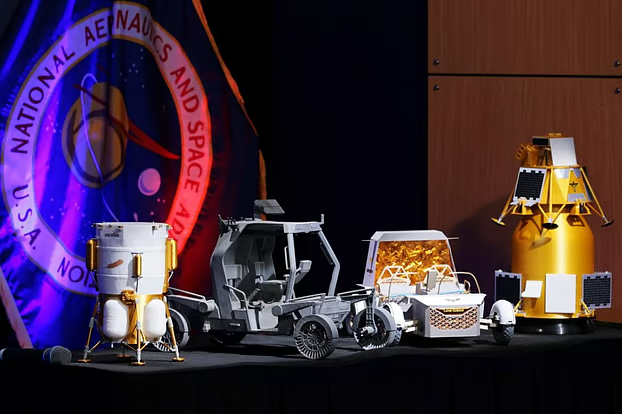
Updated plans for the ‘Moon Base’ initiative were unveiled at a press conference held at NASA headquarters in Washington, D.C. During the event, NASA showcased models of new lunar base projects developed by Blue Origin, Lunar Outpost, and other companies. May 26, 2026. Photo: Reuters.
Just a few months ago, the US space agency NASA announced plans to build a base on the Moon. The project is now moving toward implementation. NASA is formulating a detailed strategy to deliver landers, rovers, small lunar craft, and other equipment to the lunar surface.
Last Tuesday, NASA announced that it would award contracts worth approximately $590 million to three companies: Astrobotic, Firefly Aerospace, and Intuitive Machines. In exchange for this funding, the companies will transport scientific instruments and other cargo to the Moon across four missions. Astrobotic is the only company among them to have been awarded two missions.
NASA has also indicated that it is considering adapting the ‘Promis’ rover—originally designed for Mars exploration—for future use on the Moon.
These initiatives are part of a broader plan aimed at establishing essential infrastructure on the Moon using robotic vehicles, so that future human astronauts can utilize this infrastructure as a foundation for their work and habitation.
The contracts announced by NASA on Tuesday are primarily part of a grand plan to establish a permanent human settlement on the Moon, where astronauts will live and work in the future. Carlos Garcia Galan, an executive for NASA’s lunar base program, has designated the initial stage of this plan as “Phase 1.” This phase is expected to run until 2028, with an estimated cost of around $10 billion.
Last month, NASA announced several additional contracts under the first phase of this program. The second and third phases of the plan involve constructing the first pressurized lunar habitat and installing power generation systems. These steps highlight NASA’s long-term goal of gradually expanding the lunar base throughout the 2030s. Ultimately, NASA hopes that astronauts will be able to live and work in ‘semi-permanent’ settlements on the Moon.
These initiatives are part of a broader strategy by NASA to outpace China in the race for space exploration. China’s space program has made significant strides over the past decade. US lawmakers have repeatedly warned that China’s rapid progress in space technology could surpass the long-standing technological dominance of the United States.
Overcoming Obstacles
NASA is already facing several hurdles in implementing this ambitious plan.
Blue Origin, the spacecraft manufacturer owned by Jeff Bezos, had planned to send a prototype of its massive robotic lander, ‘Blue Moon,’ to the Moon’s south polar region later this year. The lunar south pole is considered particularly important because it likely holds reserves of naturally occurring ice. This ice could potentially be used to produce rocket fuel or drinking water in the future.
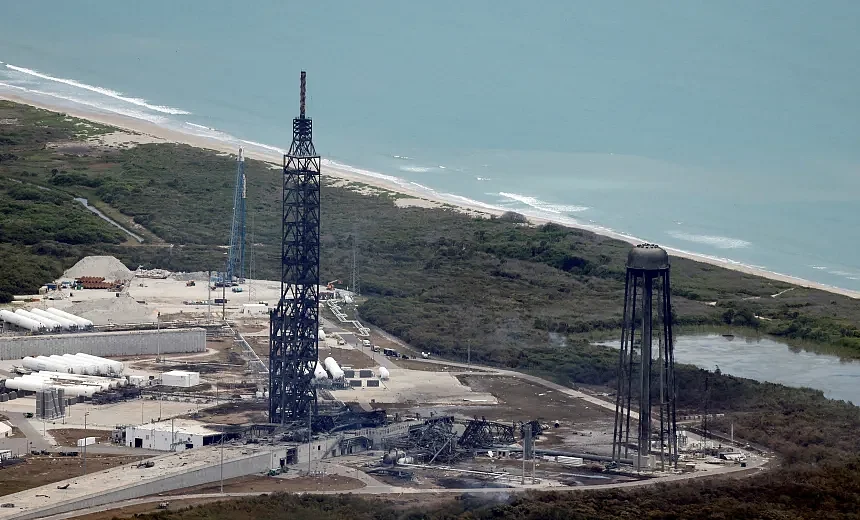
However, Blue Origin suffered a major setback in May when its ‘New Glenn’ rocket exploded unexpectedly at the launch site. The incident destroyed critical infrastructure that could take months to rebuild. Consequently, it remains unclear how much the launch of the Blue Moon mission will be delayed.
On Tuesday, Carlos Garcia Galan, an executive for NASA’s lunar base program, indicated that the Blue Moon lander could be sent using a different launch vehicle if necessary. He stated that if progress on Blue Origin’s rocket and launch facilities does not align with NASA’s schedule, the agency is considering ‘alternative arrangements.’
Meanwhile, following the New Glenn accident, NASA Administrator Jared Isaacman stated clearly in a social media message that NASA would work actively with its private-sector partners should any obstacles or issues arise.
The $30 Billion Question
Blue Origin is not NASA’s only partner. However, their ‘Blue Moon’ lander is significantly larger than most robotic spacecraft. It is slated to be built in two versions, one of which will be capable of carrying astronauts. Meanwhile, another spacecraft manufacturer, SpaceX, is continuing work on its ‘Starship’ rocket designed to transport astronauts to the Moon. However, this massive vehicle is not yet fully operational.
NASA has several other options for delivering cargo to the lunar surface. Texas-based Firefly Aerospace is the only company to date to have successfully completed a lunar mission; their ‘Blue Ghost’ lander successfully touched down near the Moon’s equatorial region last year.
Additionally, while the Texas-based company Intuitive Machines managed to send landers near the lunar south pole twice, the craft tipped over after landing in both instances.
According to NASA’s estimates, constructing a lunar base could cost approximately $30 billion.
This lunar base is a crucial component of NASA’s Artemis program. So far, about $100 billion has been spent on the program. Under this initiative, an uncrewed test mission has already been completed, as has a historic crewed mission around the Moon in April.
After more than five decades, NASA is once again preparing to land humans on the lunar surface. Their long-term goal also includes establishing a permanent settlement there.