More than 30 people have drowned in Germany during an intense heatwave. Most of them had gone swimming in rivers and lakes—activities that usually carry a low risk of such incidents in the country. The majority of the deceased were men, though the toll includes several teenagers.
According to the German Life Saving Association (DLRG), at least 26 people lost their lives while bathing or swimming between last Friday and Sunday due to the scorching heat.
Prior to that, at least seven fatal accidents occurred last Thursday. Even before the heatwave began, the DLRG had warned residents not to underestimate the risks associated with swimming or bathing in extreme heat.
On Sunday evening, the body of a 17-year-old boy was recovered from Eixer Lake in the town of Peine, Lower Saxony. Earlier, on Friday, a 14-year-old boy went missing after falling from a boat into Echtz Lake in the Düren district of North Rhine-Westphalia; his body was recovered on Sunday.
DLRG statistics include only those individuals whose identities have been confirmed; those who remain missing are excluded from this count. Among the missing are a swimmer in the Elbe River and a person in the Pohl Reservoir in Saxony.
Additionally, a 28-year-old man is missing in a quarry lake near the town of Kehl in Baden-Württemberg. According to police, he suddenly sank after diving into the water several times on Sunday and did not resurface. A friend attempted to pull him up and keep him afloat but failed. Fire service divers were also unable to locate him later. The lake was 30 to 40 meters deep at the accident site.
Another person, a 39-year-old man, is missing in Neffel Lake near Zülpich, North Rhine-Westphalia. He got into difficulty while swimming about 150 meters from the shore on Sunday evening and was heard shouting for help. A police spokesperson stated that although another swimmer rushed to rescue him, the rescuer was forced to abandon the attempt due to extreme exhaustion.
A 21-year-old swimmer had been missing in Cologne’s Fühlinger Lake until Monday. A search was also underway for an occupant of a rubber boat that had capsized in the Wesel district. Around the same time, a long-distance swimmer went under near the Scharbeutz coast of the Baltic Sea.
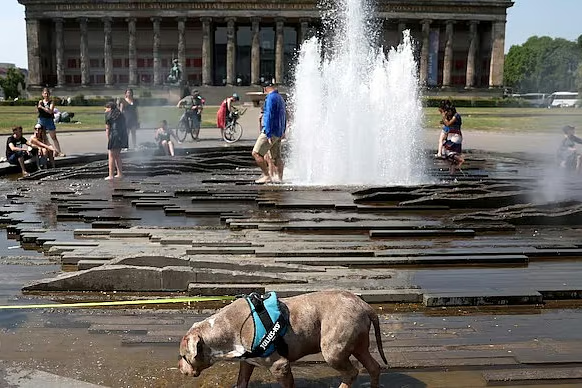
Unable to cope with the intense heatwave in Germany, many people are seeking out bodies of water to cool off. Addressing this, DLRG President Ute Vogt said, “We repeatedly see—especially among men—an overestimation of one’s own abilities and the taking of risks that could easily be avoided.”
Germany’s weather service reported a brief respite as temperatures dropped slightly following four days of intense heat. However, forecasts predict a significant rise in temperatures again between July 10 and 12.
Meanwhile, Hans Kluge, the World Health Organization’s (WHO) Regional Director for Europe, stated that the current heatwave serves as a lesson for the future. Europe appears to be burning under a prolonged period of extreme heat.
The WHO warns that this is just the beginning; future summers will be even more difficult and unbearable. Yet, many European countries remain unprepared.
According to the WHO, heatwaves are no longer isolated extreme weather events but have become a recurring crisis. They are occurring more frequently, with greater intensity, and lasting longer than in the past.
Hans Kluge noted, “More than half of the countries in Europe still lack a plan to tackle such heatwaves.”
Alongside such planning, early warning systems, cooling shelters, and special assistance for vulnerable populations could save many lives. Several countries and cities have already set positive examples in this regard.
Barcelona has expanded its network of climate-resilient shelters to over 500 locations, including libraries, parks, and pharmacies. Paris has launched a special telephone system to regularly check on vulnerable citizens and has imposed restrictions on alcohol sales during heatwaves.
Kluge said, “These are just a few examples of practical and easily implementable measures. Every city in Europe should have such preparations in place.”
According to World Health Organization statistics, more than 1,300 excess deaths were recorded in Europe within just a few weeks during the recent heatwave.
Last Sunday, the French Ministry of Health announced that the country had seen approximately 1,000 excess deaths since the previous Wednesday. The ministry further stated that a significant proportion of these excess deaths involved people over the age of 65, with the mortality rate among people in their own homes rising by 40 percent.