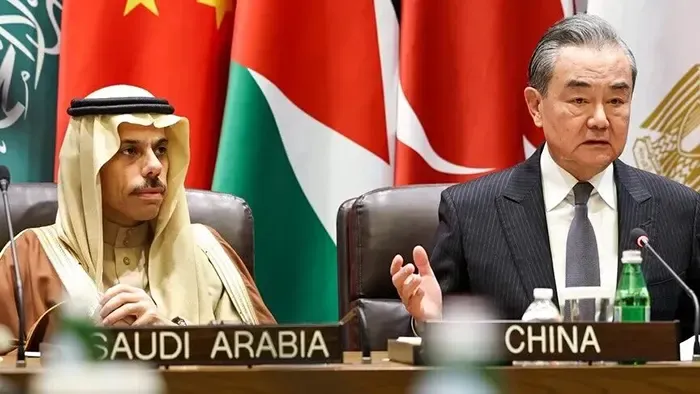
Chinese Foreign Minister Wang Yi emphasized the importance of the ongoing dialogue between the United States and Iran during a meeting with Saudi Foreign Minister Prince Faisal bin Farhan in Beijing on Tuesday. In a statement issued by the Chinese Foreign Ministry, Wang Yi outlined that priorities should include implementing and safeguarding the memorandum of understanding, maintaining the momentum of talks, overcoming obstacles and interference, and swiftly reaching a comprehensive agreement—one that is acceptable to both the US and Iran, supported by regional nations, and welcomed by the international community. This report was provided by the Anadolu Agency.
Wang Yi noted that the current ceasefire remains fragile. However, he asserted that dialogue is preferable to war, and discussion is better than direct confrontation. He further stated that China is ready to work closely with Saudi Arabia to de-escalate tensions in the Middle East and establish lasting peace and stability in the region.
Saudi Foreign Minister Prince Faisal bin Farhan stated that Saudi Arabia values China’s role in reducing tensions in the Middle East. He expressed a desire to collaborate with Beijing to restore peace and stability in the region as soon as possible. Beyond bilateral relations, the two foreign ministers discussed various regional and international issues of mutual interest. This visit took place at a time when tensions between the US and Iran have once again risen around the Strait of Hormuz.
Previously, technical-level talks had begun in Switzerland after the two nations agreed on a framework for a peace deal aimed at ending the conflict surrounding Iran. US President Donald Trump had stated that Iran expressed interest in holding a meeting. Following recent mutual attacks, representatives from both countries were expected to meet in Doha, the capital of Qatar, on Tuesday. However, Iranian Deputy Foreign Minister Kazem Gharibabadi had previously stated that no technical-level talks with the US were scheduled in Doha for that week, dismissing reports to the contrary published by US media.