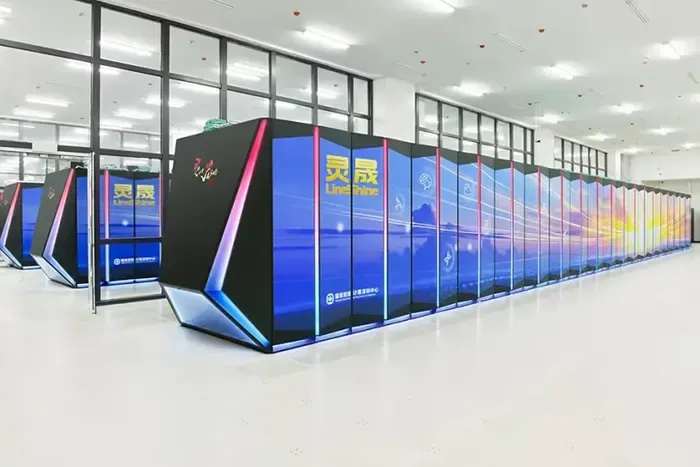
In the race for technological dominance, China has surpassed the United States to secure the top spot on the list of the world’s most powerful supercomputers. This marks the first time since 2017 that China has overtaken the US, achieving the feat with a model powered by domestically produced chips. Named “Lianxiang,” this massive machine—housed at the National Supercomputing Center in the Chinese tech hub of Shenzhen—has relegated the previous US leader, “El Capitan,” to second place on the “TOP500” list, a biannual ranking of the world’s most powerful supercomputers. CNN reported this development online.
The list, released last Tuesday, reveals that Lianxiang’s computing speed is 20 percent faster than that of El Capitan, which is located at the Lawrence Livermore National Laboratory in California. This achievement comes amidst US administration efforts to slow China’s progress through export restrictions on chips and technology imposed since 2022. In a statement, China’s National Supercomputing Center noted that Lianxiang is the result of overcoming numerous technical hurdles; securing a place in this ranking represents a historic milestone in building a fully indigenous hardware and software ecosystem while bypassing foreign technology restrictions. Notably, the Lianxiang supercomputer was built using a combination of domestically produced CPUs and high-bandwidth memory (HBM), rather than relying on conventional GPUs (Graphics Processing Units). At an awards ceremony in Hamburg, lead designer Lu Yutong explained that they broke away from the traditional CPU-GPU hybrid architecture to create this new system, which is being utilized for scientific, engineering, and AI (Artificial Intelligence) applications.
However, despite this milestone, experts caution that this list alone cannot fully measure a country’s overall AI capabilities. Andrew Lole, Director of Australia’s National Computational Infrastructure, notes that the ‘Top 500’ list measures the speed of traditional scientific computing based on a decades-old benchmark—one that is not entirely applicable to modern AI.
Furthermore, many powerful AI systems—such as those from US-based tech giants like xAI and Google, or those within the defense sector—are excluded from this list due to confidentiality or commercial reasons. Following ‘El Capitan’ (which dropped to second place), the next two spots are held by US supercomputers from Tennessee and Illinois, while a German system occupies the fifth position. Supercomputers from countries such as Italy, Switzerland, and Japan fill the remaining spots in the top ten.