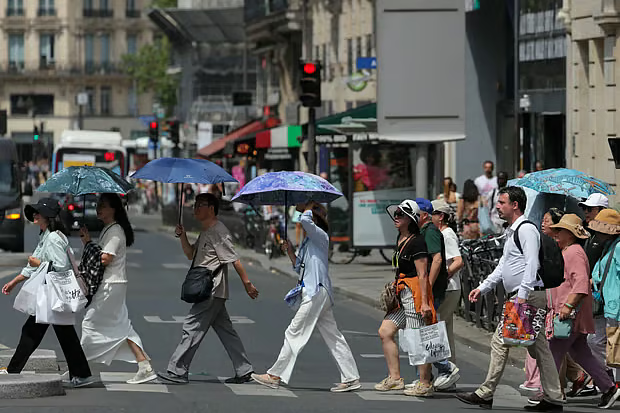
A severe heatwave is sweeping across Europe. France has recorded its highest-ever nighttime temperature. Eighteen people have died in the country due to the heat, while at least 40 others have drowned after entering the water to escape the sweltering conditions. In response, the national meteorological agency has issued the highest level of alert for 54 regions.
France’s weather agency began keeping temperature records in 1947. According to their data, the average temperature across 30 weather stations in France last Monday night was 21.6 degrees Celsius. The previous record for the highest nighttime temperature was set on July 25, 2019, when it reached 21.4 degrees Celsius.
Yesterday, Tuesday, French Prime Minister Sébastien Lecornu stated that temperatures were forecast to reach nearly 40 degrees Celsius in most parts of the country. Referring to the 40 drowning deaths, Sports Minister Marina Ferrari emphasized that swimming in unauthorized areas during a heatwave is a serious matter that cannot be taken lightly.
A 13-year-old girl died after drowning in the Seine River in France. Additionally, the bodies of two children—aged two and four—were recovered from a parked car that had become scorching hot in the sun in the city of Carpentras. Meanwhile, a young footballer rescued in critical condition from the Rhône River near Lyon is currently undergoing treatment in the hospital.

The situation is also critical in Italy. A “red alert” has been issued for 15 cities, including Rome and Milan. To protect agricultural and construction workers during the heatwave, the Italian government has reinstated special emergency labor protection laws, ensuring they do not have to work during the hottest parts of the day.
Several people have also drowned in Germany; three bodies were recovered from the Rhine River. People in Spain are also facing extreme hardship due to the heat. Temperatures are forecast to reach 40 degrees Celsius in San Sebastián, a city in the country’s typically cooler northern region. Spain’s meteorological agency has reported that heatwaves are occurring much more frequently in the country than in the past. Since 2000, the country has experienced ten severe heatwaves, whereas only two such events occurred in the preceding 25 years.
Meanwhile, the UK’s meteorological office announced on Monday that temperatures could exceed 39 degrees Celsius in some parts of the country during a four-day heatwave.
Claire Barnes, a climate researcher at Imperial College London, stated that a weather pattern known as an “Omega block” is drawing warm air from North Africa—specifically the Sahara Desert—causing the intense heat. Heatwaves and storms are becoming increasingly severe due to climate change.