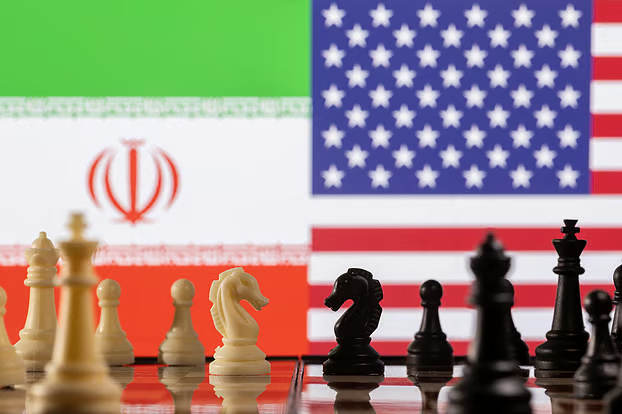
US Vice President JD Vance has postponed his scheduled visit to Switzerland, where discussions were to be held regarding the next steps following the agreement between the US and Iran aimed at halting the conflict in the Middle East.
The Swiss Foreign Ministry confirmed the postponement of the talks between the US and Iran, though preparations for discussing the final agreement are reportedly underway.
According to the White House, the discussions were scheduled to begin today, Friday.
Late Thursday night, a White House spokesperson stated, “The overall preparation and logistics for these talks were never simple or predictable. Given the current situation, the Vice President is not departing tonight.”
The spokesperson added, “We look forward to commencing technical discussions as soon as possible.”
It is worth noting that a Memorandum of Understanding (MoU) between the US and Iran was officially scheduled to be signed in Geneva today. This had been confirmed by Iran, the US, and the mediating nation, Pakistan. However, the MoU was signed unexpectedly a day early, on Wednesday night (Bangladesh time).
A White House spokesperson stated that the overall preparation and logistics for these talks were never simple or predictable. Given the current situation, the Vice President is not departing tonight (Thursday night).
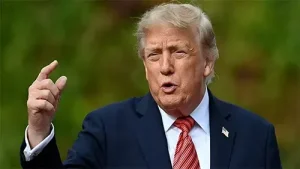
US President Donald Trump signed the MoU virtually from France, while Iranian President Masoud Pezeshkian signed from Tehran.
Later, Iranian Parliament Speaker Bagher Ghalibaf announced that the formal signing of the preliminary agreement (MoU) would not take place in Geneva on Friday (today). However, the country indicated that discussions regarding the final agreement would begin on that day.
The talks were scheduled to take place at a mountain-top resort, with representatives from Iran, the US, and mediating nations—including Pakistan and Qatar—in attendance. The discussions were slated to last for 60 days, covering topics such as Iran’s nuclear program and the release of frozen assets.
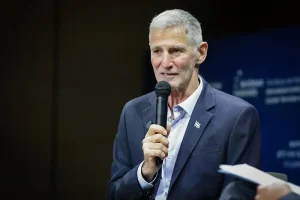
If Israel continues its attacks in Lebanon, Iran might withdraw from the agreement. The responsibility of restraining Israel rests with the United States. —Mostafa Koscheshm, Professor at the University of Applied Sciences, Tehran
However, it took nearly two years to finalize the 2015 nuclear deal with Iran. Consequently, journalists asked Donald Trump about the 60-day timeframe for the current talks. He stated that as long as Iran “behaves properly,” he would not worry about this deadline.
Iran has hailed the memorandum signed on Wednesday as “historic.” While the country remains optimistic, concerns persist regarding the United States and Israel. Immediately after the memorandum was signed, US President Trump issued a threat, stating that Iran would be attacked if it failed to adhere to the terms of the agreement. Meanwhile, Israel continues to launch attacks in Lebanon, defying the spirit of the memorandum.
Despite these concerns, the signing of this memorandum by the US and Iranian presidents marks the most significant development since the war began on February 28. More than 7,000 people have lost their lives in the conflict, including Iran’s Supreme Leader Ayatollah Ali Khamenei and numerous other high-ranking officials. Furthermore, the war has triggered economic instability, the impact of which is being felt globally, including in Bangladesh.
Nevertheless, there are signs of improvement following the signing of the memorandum. Reports indicate that, in accordance with the agreement, several vessels—including a French-flagged ship—passed through the Strait of Hormuz yesterday, Thursday. Additionally, eleven Iranian ships departed from the country’s ports and headed toward their destinations. On the same day, the price of oil dropped below $79 per barrel.
In this context, Mostafa Koscheshm, a professor at the University of Applied Sciences in Tehran, believes the United States bears the primary responsibility for ensuring the agreement’s sustainability. He, too, views Israel as a source of concern.
Speaking to Al Jazeera, the professor noted that if Israel persists with its attacks in Lebanon, Iran might withdraw from the agreement. The responsibility for keeping Israel in check lies squarely with the United States.